
From the 9-1-1 Center to the Tactical Edge
C-AT helps public safety agencies connect the systems, teams, and vehicles that response depends on.
C-AT connects public safety communications across dispatch, command, field teams, response vehicles, radios, LTE/PTToC, satellite, cellular, VoIP, and phone systems.
Meet C-AT at APCO 2026 in San Antonio to see ICRI radio interoperability and ComForce vehicle intercom capabilities built for complex, multi-agency operations.
What is ICRI?
ICRI, the Incident Commanders’ Radio Interface by Communications-Applied Technology, is a portable interoperability gateway that connects radios, LTE/5G, satellite, cellular, VoIP, PTToC, MESH, and phone systems across agencies.
It gives dispatch, command, field response, mutual aid, and tactical teams a fast way to communicate across different systems without new infrastructure, radio reprogramming, or encryption key sharing.
What does ICRI do?
ICRI bridges incompatible communication systems so agencies can communicate during incidents, disasters, and multi-agency operations in real time.
Does ICRI require towers or repeaters?
No. ICRI operates independently of towers, repeaters, or existing communications infrastructure.
Can ICRI connect different radio bands?
Yes. ICRI supports HF, VHF, UHF, 700/800 MHz, P25, trunked, PTToC, MESH radio, LTE, satellite, cellular, VoIP, and conventional phone systems.
Does ICRI require radio reprogramming?
No. Radios remain on their existing frequencies. ICRI bridges them together in real time without changing existing agency configurations.
Who uses ICRI?
ICRI supports the agencies and teams responsible for coordinated response, including emergency management, public safety, military, federal response, dispatch, mutual aid, and multi-agency incident command operations.
What is ComForce?
ComForce is C-AT’s vehicle intercom system for public safety, defense, utility, mobile command, and specialty response vehicles. It supports clear crew communication inside and around high-noise vehicles while helping teams stay connected to vehicle radio communications.
ComForce is designed for crews that need a practical way to coordinate between driver, officer, operator, and crew positions during mobile response operations. For APCO attendees, ComForce gives C-AT a vehicle communications solution to discuss with agencies managing fire apparatus, rescue vehicles, mobile command vehicles, utility response vehicles, and specialty public safety platforms.
How does ComForce support vehicle crews?
ComForce helps vehicle crews communicate clearly inside and around public safety vehicles while staying connected to radio communications. It supports driver, officer, crew, and operator coordination in fire, rescue, mobile command, utility, and specialty response vehicles.
Who should meet C-AT at APCO 2026?
Public safety communications leaders should meet C-AT at APCO 2026 if they are responsible for keeping dispatch, command, field responders, vehicle crews, mutual aid partners, or remote teams connected during complex incidents.
C-AT is a strong fit for ECC and PSAP leaders, dispatch supervisors, radio system managers, COML and COMT personnel, emergency management teams, public safety IT leaders, fire and rescue leadership, mobile command teams, utility and transportation agencies, and federal, state, local, and regional response partners.
At APCO 2026, C-AT will feature ICRI radio interoperability and ComForce vehicle intercom capabilities for agencies that need practical communications options across radios, LTE/PTToC, satellite, VoIP, phone systems, response vehicles, and field operations.
How can ComForce support fire and rescue vehicles?
ComForce can support fire and rescue vehicle crews by improving communication between the driver, officer, crew members, operators, and vehicle radio positions in loud mobile environments.
Fire and rescue operations often require teams to coordinate before arrival, while staged, during movement, and around the vehicle. ComForce gives agencies a purpose-built intercom path for crew coordination in fire apparatus, rescue units, mobile command vehicles, and specialty response platforms.
For agencies evaluating fire apparatus communications, ComForce can help connect the vehicle crew to each other and to vehicle radio communications without treating the vehicle as separate from the broader response chain.
Modern Systems Still Break Down During Complex Incidents
APCO attendees know the problem is not whether public safety has communications technology. The problem is whether dispatch, command, field teams, mutual aid partners, vehicle crews, and outside agencies can stay connected when the incident grows beyond the original plan.
Large incidents now involve more agencies, more systems, more data paths, more vehicles, and more pressure on emergency communications centers.
Infrastructure can fail. Networks can overload. Communications centers can be pushed beyond normal operations. Crews may be operating inside loud vehicles, outside the vehicle, or across separate response assets.
When the response expands, communications have to expand with it.
Incidents Keep Proving the Same Point
Public safety communications have improved.
The operational environment has become harder.
Large incidents now involve more agencies, more systems, more data paths, and more pressure on emergency communications centers.
Whether the challenge starts in dispatch, on the radio system, in a mobile command post, or inside a response vehicle, the pattern is the same: agencies need practical communications paths that work across operating conditions.
Texas Hill Country
Floods
The 2025 Hill Country floods exposed radio interoperability problems between responding agencies. Reports described incompatible and outdated radio systems, loaner radios, and communication gaps during search and rescue operations.
Texas Panhandle
Wildfires
The Texas Panhandle wildfires showed how large mutual aid responses can expose communications problems between local responders, state agencies, law enforcement, and outside support teams.
Hurricane Helene
Response
After Hurricane Helene, communications centers and telecommunicators operated under extreme pressure. APCO’s incident review described TERT deployments, mobile command support, and temporary communications restoration efforts.
Mission-Critical
Voice
NIST’s 2025 Mission Critical Voice Roundtable Report focused on public safety voice communications, LMR, broadband, push-to-talk, interoperability, and the transition to new technologies.
Sources: KSAT, Houston Chronicle,AP News, APCO International, NIST.
Where ICRI Fits With Systems You Already Have
C-AT does not compete with the systems agencies have already invested in. C-AT helps connect them when an incident includes systems, agencies, vehicles, or field conditions that were not planned to work together.
ICRI connects communications systems across agencies and operations. ComForce supports clear crew communication inside and around response vehicles. Together, they help agencies extend communications from the ECC to command, field teams, and mobile response assets.
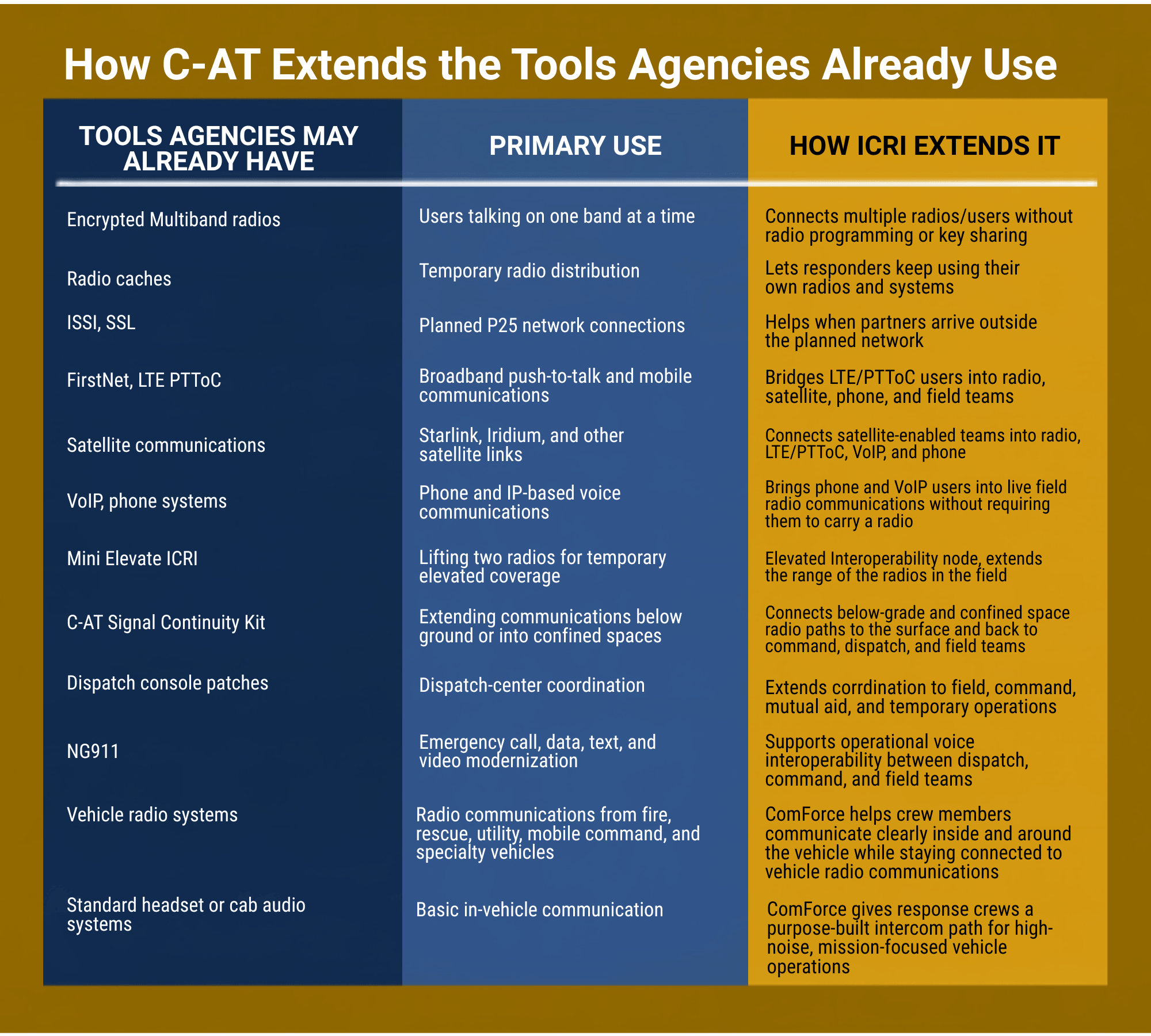
Multiband Radios Help. They Do Not Solve Every Incident.
Modern multiband radios are valuable. P25 systems, ISSI/CSSI, FirstNet, LTE push-to-talk, and NG911 upgrades all improve public safety communications.
But incidents do not always bring perfectly aligned systems.
Mutual aid partners may arrive with different radio manufacturers, older analog radios, unplanned talkgroups, LTE/PTToC platforms, satellite links, aviation assets, phone systems, or temporary command posts. Dispatch may need to coordinate with agencies that were never programmed into the original plan.
ICRI does not compete with those investments. It helps connect them.
ICRI is the interoperability layer agencies use when the incident includes systems that were not planned to work together.
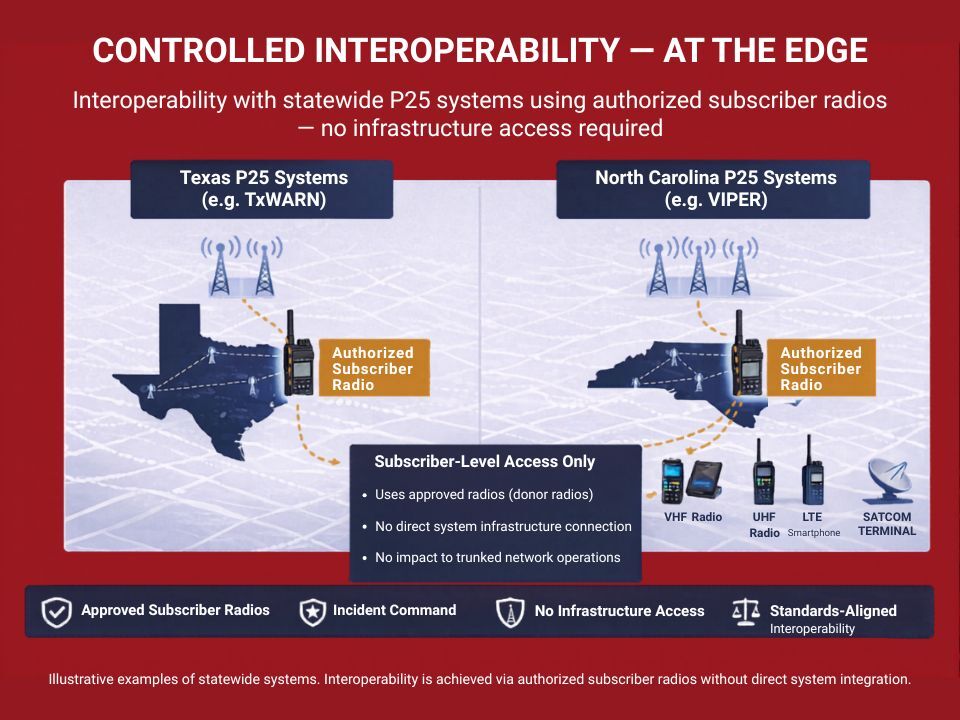
C-AT Connects the Full Response Chain
C-AT gives communications centers, incident command, field responders, mutual aid teams, vehicle crews, and tactical operators practical ways to connect across systems without waiting for programming, infrastructure recovery, or network changes.
ICRI bridges LMR, P25, trunked radio, LTE/PTToC, MESH radio, satellite, cellular, VoIP, and phone systems in real time.
ComForce supports crew communications inside and around public safety vehicles, helping drivers, officers, operators, and response teams stay aligned during mobile operations.
Dispatch, command, field teams, and vehicle crews stay connected using the equipment they already have.
When the Call Expands, Dispatch Needs More Than One Path
Emergency communications centers are often the first to feel the pressure when a routine call becomes a multi-agency response.
Dispatchers may need to coordinate field responders, command staff, mutual aid agencies, utilities, transportation, law enforcement, fire, EMS, mobile command vehicles, and outside support teams across different systems.
When dispatchers are coordinating multiple agencies under pressure, they need communications paths that keep command, field responders, vehicle crews, and outside support teams aligned.
ICRI gives communications leaders another path to connect people, radios, phones, LTE/PTToC users, satellite links, and command posts when the incident grows beyond normal channels.
ComForce supports the vehicle side of that response by helping crews communicate clearly inside and around response vehicles while staying tied to the broader communications plan.
As 9-1-1 Modernizes, Voice Interoperability Still Has to Work
NG911 will expand what emergency communications centers can receive, route, and share. That transition also increases the need for strong continuity planning across IP networks, radio systems, broadband platforms, vehicle communications, and field operations.
ICRI supports the voice interoperability side of that continuity plan by helping agencies connect across legacy systems, broadband platforms, radio networks, satellite links, and field communications equipment.
ComForce helps extend that continuity into response vehicles by supporting clear crew and radio communications during mobile operations.
Important Note: ICRI does not replace NG911 infrastructure. ComForce does not replace mobile radio systems. C-AT supports operational communications when responders, command, communications centers, and vehicle teams need to coordinate across systems.
Vehicle Communications Are Part of the Response Chain
Public safety vehicles are more than transportation. They are moving communications points for crews, command, rescue teams, utilities, and specialty response operations.
ComForce Vehicle Intercom System helps crew members communicate clearly inside and around high-noise vehicles while staying connected to vehicle radio communications.
For agencies evaluating fire apparatus, rescue units, mobile command vehicles, utility response vehicles, or specialty public safety platforms, ComForce gives C-AT a practical vehicle communications capability to discuss at APCO 2026.
ICRI Connects
ICRI bridges communications systems that normally cannot communicate with each other during incidents, mutual aid operations, planned events, and infrastructure failures.
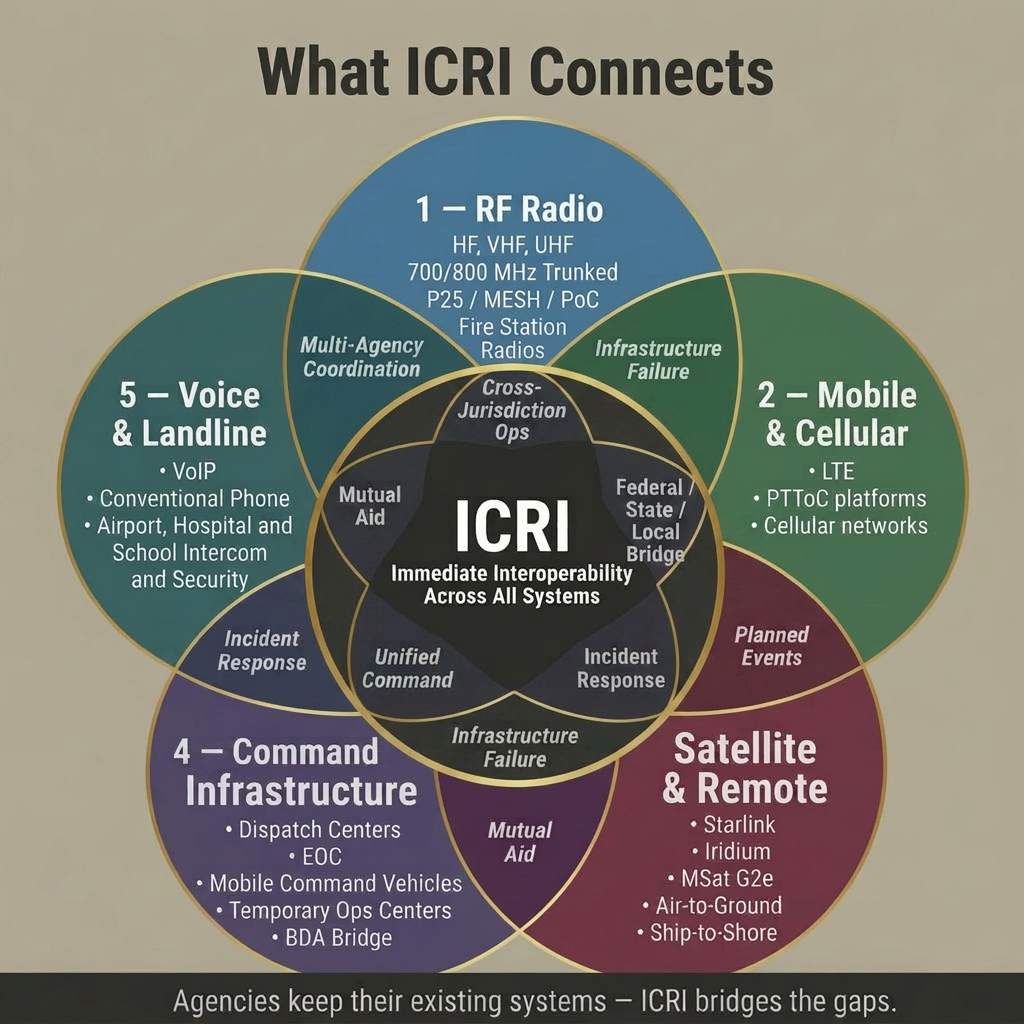
The ICRI connects without subscriptions and programming.
Agencies continue using their existing radios, phones, and communications systems while establishing immediate interoperability across teams, jurisdictions, and response functions.
When the Problem Is Not Just Interoperability
APCO attendees know communications problems are not always caused by incompatible systems. Sometimes the issue is building penetration, below-grade coverage, blocked RF paths, terrain, distance, failed BDA coverage, vehicle noise, or the need to quickly elevate a temporary communications point.
C-AT supports the full communications chain with tools that help agencies connect systems, extend radio access, improve vehicle crew communications, and improve field communications reach during complex public safety operations.
ICRI Radio Interoperability Gateway
Connect dispatch, command, field teams, mutual aid partners, LMR, LTE/PTToC, satellite, VoIP, and phone systems without radio reprogramming or system replacement.
CSCK - Confined Space Communications Kit
Support responder communications in schools, tunnels, below-grade spaces, large structures, shielded areas, and locations where BDA coverage is unavailable, degraded, or not reaching responders.
C-AT Mini Elevate
Use a drone-elevated Mini ICRI and two radios to create a temporary elevated interoperability point when terrain, buildings, distance, or blocked RF paths limit ground-level communications.
ComForce Vehicle Intercom System
Support clear crew communication inside and around public safety vehicles, including fire, rescue, mobile command, utility, and specialty response platforms.
Beyond Local Coverage
Support long-haul communications between field teams, command posts, EOCs, and remote coordination sites using LMR-to-SATCOM and deployable satellite-enabled communications paths.
Meet C-AT at APCO 2026
C-AT should meet with public safety communications leaders, ECC and PSAP managers, dispatch supervisors, radio system managers, COML/COMT personnel, emergency management teams, public safety IT leaders, utilities, transportation agencies, fleet and vehicle communications stakeholders, fire and rescue leaders, and mutual aid coordinators responsible for keeping agencies connected during complex incidents.
- ECC and PSAP leaders
- Dispatch supervisors and telecommunicators
- Radio system managers
- COML and COMT personnel
- Public safety IT teams
- Emergency management agencies
- Law enforcement, fire, and EMS leadership
- Fire apparatus and fleet decision-makers
- Mobile command vehicle teams
- Utilities and transportation agencies
- Mutual aid coordinators
- Federal, state, local, and regional response partners
Keep Dispatch, Field Teams, Vehicles, and Remote Sites Connected
When a call expands into a multi-agency response, communications cannot depend on perfect planning, identical radios, a single network path, or vehicle systems that operate separately from the response plan.
C-AT gives agencies practical communications tools that connect dispatch, command, field teams, vehicle crews, mutual aid partners, and remote coordination sites without reprogramming, additional subscription fees, or replacing existing systems.
Bring Your Hardest Communications Scenario
Ask C-AT how ICRI and ComForce help agencies connect different radios, LTE/PTToC tools, satellite links, phone systems, dispatch paths, vehicle crews, and field operations without reprogramming or replacing existing systems.
- How do we connect mutual aid partners quickly?
- How do we support dispatch-to-field communications?
- What happens when infrastructure is down or overloaded?
- How does ICRI work alongside multiband radios, FirstNet, P25, ISSI/CSSI, and NG911?
- How can we improve crew communication inside fire, rescue, mobile command, or specialty response vehicles?
- How can C-AT support communications inside schools, tunnels, below-grade spaces, or failed BDA areas?
- How does a drone-elevated Mini ICRI create a temporary communications repeater?
- How do we extend communications beyond local coverage using LMR-to-SATCOM or deployable satellite-enabled paths?
- Is there a way to extend the communications path between the ICRI and the ComForce Vehicle Intercom for long haul comms without additional subscriptions?
Built by C-AT for Public Safety and Mission-Critical Communications
Communications-Applied Technology has supported public safety, emergency management, defense, and multi-agency communications operations since 1982. C-AT systems are made in the USA and built for teams that need practical communications tools in difficult operating environments.
Made in the USA
Supporting public safety and defense since 1982
Portable radio interoperability gateway
No radio reprogramming required
Works with existing communications equipment
Designed for field, command, dispatch, and multi-agency operations
REQUEST AN INTEROPERABILITY CONSULTATION
Connect with C-AT to discuss your agency’s communications requirements, schedule a demonstration, or evaluate ICRI for public safety communications, ECC operations, dispatch-to-field coordination, mutual aid, and tactical field response.
FAQ's
What is ICRI?
ICRI, the Incident Commanders’ Radio Interface by Communications-Applied Technology, is a portable interoperability gateway that connects radios, LTE/5G, satellite, cellular, VoIP, PTToC, MESH, and phone systems across agencies.
It gives dispatch, command, field response, mutual aid, and tactical teams a fast way to communicate across different systems without new infrastructure, radio reprogramming, or encryption key sharing.
What is a radio interoperability gateway?
A radio interoperability gateway connects different communications systems so agencies can communicate across radios, LTE/PTToC, satellite, VoIP, cellular, and phone systems without requiring every user to operate on the same network.
What is ComForce?
ComForce is C-AT’s vehicle intercom system for public safety, defense, utility, mobile command, and specialty response vehicles. It supports clear crew communication inside and around high-noise vehicles while helping teams stay connected to vehicle radio communications.
ComForce is designed for crews that need a practical way to coordinate between driver, officer, operator, and crew positions during mobile response operations. For APCO attendees, ComForce gives C-AT a vehicle communications solution to discuss with agencies managing fire apparatus, rescue vehicles, mobile command vehicles, utility response vehicles, and specialty public safety platforms.
How can ComForce support fire and rescue vehicles?
ComForce can support fire and rescue vehicle crews by improving communication between the driver, officer, crew members, operators, and vehicle radio positions in loud mobile environments.
Fire and rescue operations often require teams to coordinate before arrival, while staged, during movement, and around the vehicle. ComForce gives agencies a purpose-built intercom path for crew coordination in fire apparatus, rescue units, mobile command vehicles, and specialty response platforms.
For agencies evaluating fire apparatus communications, ComForce can help connect the vehicle crew to each other and to vehicle radio communications without treating the vehicle as separate from the broader response chain.
Why would an agency need ICRI if it already has multiband radios?
Multiband radios help individual users operate across multiple bands, but complex incidents often include different agencies, legacy radios, LTE/PTToC tools, satellite links, phone systems, dispatch paths, and unplanned mutual aid partners. ICRI helps connect those systems without requiring every responder to carry the same radio .
Does ICRI require radio reprogramming?
No. ICRI connects existing radios and communications systems in real time without changing agency frequencies or radio configurations.
Can ICRI support dispatch-to-field communications?
Yes. ICRI can help connect emergency communications centers, incident command, field teams, mutual aid partners, and remote coordination sites across different communications systems.
How does ICRI support ECC and PSAP operations?
ICRI supports ECC and PSAP operations by helping connect dispatch, command, field responders, mutual aid partners, and remote coordination sites across different communications systems during complex incidents.
What systems can ICRI connect?
ICRI supports HF, VHF, UHF, 700/800 MHz, P25, trunked, PTToC, MESH radio, LTE, satellite, cellular, VoIP, and conventional phone systems. The ICRI is an audio bridge and is field-proven to link the audio from devices in multiple environments.
Is ICRI a replacement for NG911?
No. ICRI does not replace NG911 infrastructure. It supports operational voice interoperability when dispatch, command, and responders need to communicate across systems during incidents.
What is the C-AT Mini Elevate?
The C-AT Mini Elevate uses a drone-elevated Mini ICRI and two radios to create a temporary elevated interoperability point for field operations when terrain, buildings, distance, or blocked RF paths limit ground-level communications.
What is CSCK?
CSCK, the C-AT Signal Continuity Kit supports responder communications in confined spaces such as schools, tunnels, ships, below-grade spaces, large structures, shielded areas, and locations where BDA coverage is unavailable, degraded, or not reaching responders.
Where can I see ICRI and ComForce at APCO 2026?
C-AT will attend APCO 2026 in San Antonio, Texas, where public safety communications leaders can discuss ICRI radio interoperability and ComForce vehicle intercom capabilities with the C-AT team.
APCO attendees can meet with C-AT to review communications challenges involving dispatch-to-field coordination, radio interoperability, mutual aid, LTE/PTToC, satellite links, VoIP, phone systems, vehicle crew communications, fire and rescue vehicles, mobile command platforms, confined space communications, and field response operations.
Visit C-AT at APCO 2026 to discuss how ICRI and ComForce can support your agency’s communications requirements.
REQUEST AN INTEROPERABILITY CONSULTATION
Connect with C-AT to discuss your agency’s communications requirements, schedule a demonstration, or evaluate ICRI for public safety communications, ECC operations, dispatch-to-field coordination, mutual aid, and tactical field response.
Interested in long-haul communications?
C-AT’s Starlink-enabled field communications capability gives your agency secure edge first Interoperability anywhere in the world.